
Are Peptides Steroids? What to Know Before Considering Treatment
No. Peptides are not anabolic steroids. Peptides are short chains of amino acids, while anabolic steroids belong to a different chemical class related to testosterone. But that distinction does not tell you whether a particular peptide medication is safe, effective, or appropriate for you.
If you have been reading about peptides, you have probably encountered conflicting descriptions: “natural signaling molecules,” “hormone treatments,” or even “steroid alternatives.” Those phrases can make very different substances sound interchangeable.
The useful question is which substance is being discussed, what it is intended to treat, and what evidence supports that use.
Why Are Peptides Sometimes Confused With Steroids?
Peptides and anabolic steroids often appear in the same online conversations about fitness, recovery, and aging. Marketing may also group them together because some products are injected or can affect hormonal pathways.
Neither characteristic makes them the same type of substance. An injection describes how a medication enters the body, not what the medication is.
The word steroid also needs clarification. In discussions comparing peptides with steroids, people usually mean anabolic-androgenic steroids, which copy effects of hormones such as testosterone. These differ from corticosteroids, another group of medicines used for conditions involving inflammation and other medical needs. The NHS explains this distinction in its guide to anabolic steroids.
For this comparison, “steroids” means anabolic-androgenic steroids.
Peptides vs. Steroids: What Is the Difference?
A peptide is a short chain of amino acids connected by peptide bonds. Amino acids also form the building blocks of proteins. The sequence of a peptide helps determine its properties and biological activity. The National Human Genome Research Institute provides a short explanation of peptide structure.
Steroid hormones have a different chemical structure and are derived from cholesterol. Testosterone is one example. Some peptides also act as hormones, but having a hormonal role does not make a substance a steroid. These categories are described in Principles of Endocrinology, available through NCBI Bookshelf.
| Question | Peptides | Anabolic-androgenic steroids |
|---|---|---|
| What are they made of? | Chains of amino acids | Molecules with a steroid ring structure, related to testosterone |
| Do they all have the same effect? | No. Different peptides can have very different functions. | They share anabolic and androgenic activity, although individual drugs differ. |
| Are they hormones? | Some are; others are not. | They act like androgen hormones. |
| Does the category establish safety? | No. The exact substance and product matter. | No. The drug, dose, purpose, and patient matter. |
| Are they interchangeable treatments? | No | No |
This comparison explains the terminology. It does not establish that one category is universally better or safer.
Are Peptides Hormones?
Some peptides are hormones, but not all peptides are hormones. These words describe different things:
- Peptide describes a molecule’s structure.
- Hormone describes a signaling role in the body.
- Medication describes a substance used for a medical purpose.
A molecule can fit more than one description. Insulin, for example, is a peptide hormone. Testosterone is a steroid hormone. Both participate in hormonal signaling, but they have different structures and functions.
That is why broad statements such as “peptides do not affect hormones” or “all peptides stimulate hormone production” are misleading. The answer depends on the specific peptide.
A peptide medication also should not be assumed to replace prescribed testosterone or another hormone treatment. Different treatments address different medical needs.
Are Peptides Safer Than Steroids?
There is no reliable blanket answer. Comparing “peptides” with “steroids” without naming the substances leaves out the information needed to assess risk. A well-studied prescription medication and an experimental compound sold online may both be described as peptides, yet have very different evidence behind them.
Anabolic steroid misuse has documented risks, including cardiovascular, reproductive, and psychological effects. Those risks do not prove that an unrelated peptide product is safe.
For certain substances proposed for compounding, the FDA has identified concerns involving immune reactions, peptide-related impurities, or limited human safety information. These concerns vary by substance. See the FDA’s information on bulk substances that may present significant safety risks.
A useful safety discussion should address:
- The exact active ingredient and formulation.
- Evidence for the proposed medical use.
- Known risks and important uncertainties.
- Your health conditions and current medications.
- The product’s source and regulatory status.
- How treatment would be monitored.
“Natural,” “targeted,” and “not a steroid” are descriptions. They are not evidence that a treatment is appropriate.
Are Peptides FDA-Approved?
FDA approval applies to specific drug products and uses, not to the word “peptide” as a whole.
When discussing a proposed medication, ask for its exact name and whether the intended use is included in its approved labeling. If the proposed use is off-label, ask what evidence supports it and what uncertainties remain.
Compounded preparations require a separate distinction. The FDA states that compounded drugs are not FDA-approved and are not reviewed by the agency for safety, effectiveness, or quality before marketing. Compounding can meet certain patient needs, but it is not the same as approval of the finished product. The agency explains this in its compounding questions and answers.
A prescription or a pharmacy’s involvement should therefore not be interpreted as proof of FDA approval.
What About Peptide Side Effects?
There is no single side-effect profile that applies to every peptide. A general list can be misleading: it may suggest that every substance causes the same problems, or that anything missing from the list is risk-free.
Instead, ask for information specific to the proposed medication: Which effects are common? Which are serious? What is known about longer-term use? Which symptoms should prompt a call or urgent medical attention?
The answers should distinguish established findings from gaps in the evidence. Limited safety data should be explained as uncertainty, rather than presented as an absence of risk.
Questions to Bring to a Consultation
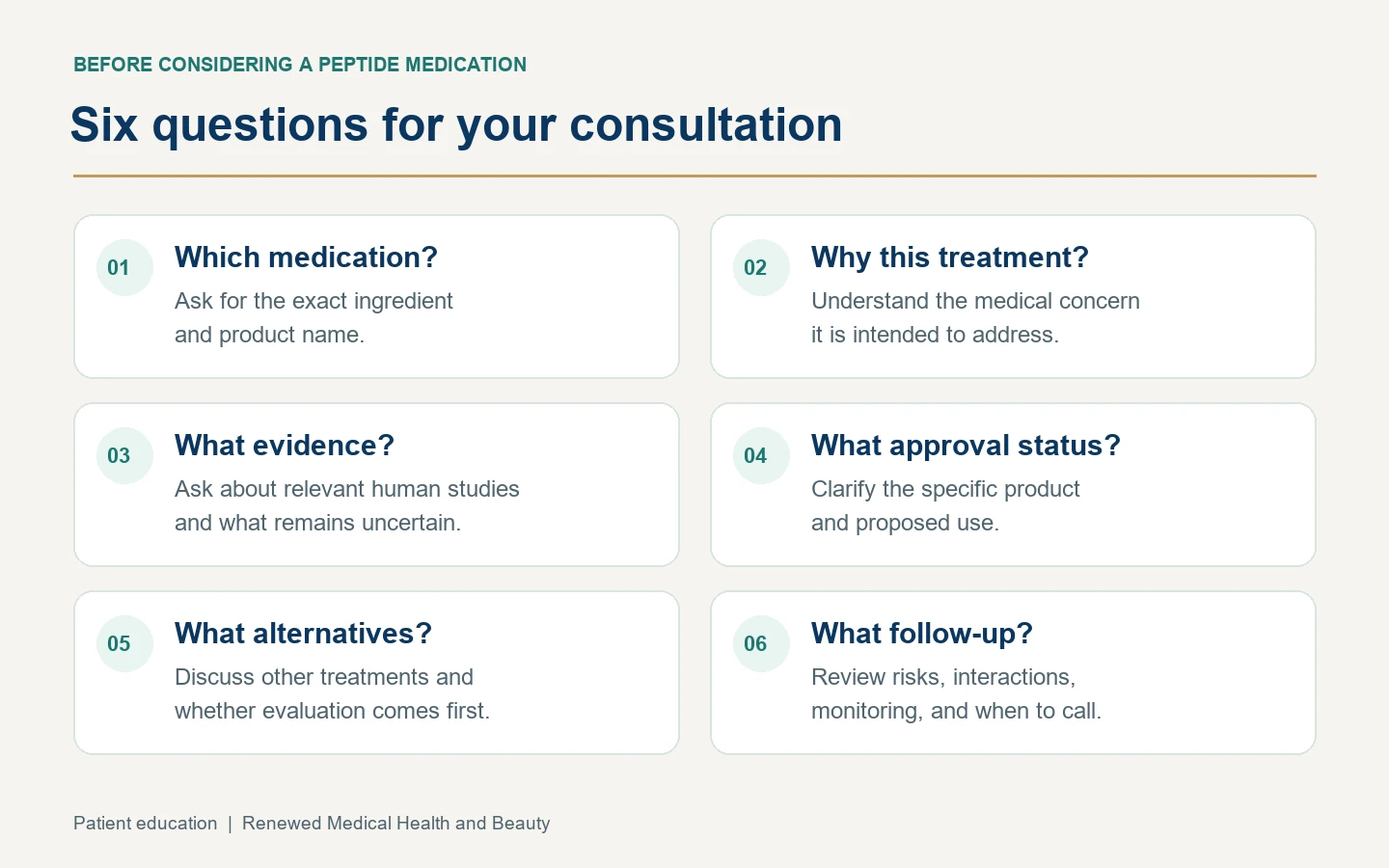
You do not need to understand every biochemical term before an appointment. You should, however, leave with a clear explanation of what is being proposed and why.
- What exactly are you recommending?
Ask for the active ingredient and product name, rather than accepting “a peptide” as the full explanation. - What medical concern would it address?
Discuss your symptoms and goals before choosing a treatment. - What evidence supports this use?
Ask whether the findings come from human studies relevant to your situation, rather than laboratory research alone. - What is the product’s approval status?
Clarify whether it is an FDA-approved medication, whether the proposed use is off-label, or whether it is a compounded preparation. - What are the alternatives?
Discuss other established treatments and whether further evaluation should come first. - How would we decide whether to continue?
Ask about follow-up, realistic measures of benefit, potential interactions, and reasons to stop or reconsider treatment.
Bring a list of medications and supplements, along with any relevant previous reactions or treatment history.
Frequently Asked Questions
Are peptides the same as anabolic steroids?
No. Peptides are amino acid chains, while anabolic steroids have a different chemical structure related to testosterone. They are not interchangeable, even when discussed for similar goals.
Are all peptides hormones?
No. Some peptides serve as hormones, while others have different functions. “Peptide” describes structure; “hormone” describes a signaling role.
Are peptides safer than steroids?
The category alone cannot answer that question. Safety depends on the specific substance, product, intended use, dose, and individual patient. A peptide should not be described as safer simply because it is not a steroid.
Can peptides cause side effects?
Yes, peptide medications can have adverse effects. The relevant risks depend on the exact medication and how it is used. Ask for product-specific information rather than relying on a general peptide side-effect list.
Are all peptide medications FDA-approved?
No. Approval must be checked for the specific product. Compounded preparations are not FDA-approved, even when prescribed.
What should I ask before considering peptide treatment?
Start with the exact medication, the reason for recommending it, evidence supporting that use, approval status, risks, alternatives, and follow-up plan. If those points remain unclear, ask for clarification before making a decision.
A Clearer Conversation About Treatment
For information about the clinic’s approach, explore peptide therapy at Renewed Medical. A consultation is an opportunity to discuss suitability and alternatives; it does not mean that a particular medication will be recommended.
The cover is an AI-generated conceptual illustration, not a clinical photograph or a precise molecular diagram. This article is general educational information and does not replace an individual medical evaluation.